Tuesday, 28 January 2014

Parents: Sex education to your children is vital 20th January 2014

Parents: Sex education to your children is vital


The schooling children are in the longest holiday of the year. It is assumed that parents are having discussions with them on almost every topic of their lives. But it is not the case; very few children are receiving attention from their “working” parents and most children, irrespective of their age from a baby class child to a high school graduate watch movies and soaps from sunrise to sunset.

I found two young children watching a Western (Hollywood) movie and a scene about sex was going to happen next, they both covered their faces. These two kids knew that the next action was going to be about sex.  When I asked them how they knew they could not give me an answer.

I was so inquisitive to know whether they have received any kind of sex education. Their answer was no, they neither received education from parents nor teachers.

According to a report, “Protecting the next generation in Uganda: New Evidence on Adolescent Sexual and Reproductive Health Needs”, published by Guttmacher Institute in 2008, only 33.8% of  girls and 22% of  boys aged  between 12 and 14 have received sex education in school. At home, 71% of girls and 64% of boys had never talked to parents about sex related matters.

Sex education is a topic many parents would prefer to avoid. And if you have a young child, you might think you are off the hook at least for a while. But that is not necessarily true. Sex education can begin any time.

Few young people receive adequate preparation for their sexual lives. This leaves them potentially vulnerable to coercion, abuse and exploitation, unintended pregnancy and sexually transmitted diseases and infection including HIV.

Many young people approach adulthood faced with conflicting and confusing messages about sexuality and gender. This is often exacerbated by embarrassment, silence and disapproval of open discussion of sexual matters by adult including parents and teachers at the very time when it is most needed.

Each year teens in Uganda experience as many pregnancies (25% of the adolescent girls become pregnant before the age of 19) and the youth experiences sexually transmitted infections. By the age of 18 the highest percentage of male and female has at least initiated sex.

Comprehensive sex education is effective at assisting young people to make healthy decisions and to adopt healthy sexual behaviours. No abstinence only until marriage programme has shown to help teens delay sex. Yet the government and religious institutions have spent a lot supporting abstinence only until marriage.

Although the Uganda government ignores that adolescents have a fundamental human right to accurate and comprehensive sexual health information, evidence has shown that comprehensive sex education that is age – appropriate, gender – sensitive and life skills based, can provide young people with the knowledge skills and efficacy to make informed decisions about their sexuality and lifestyle.

When young people are equipped with accurate and relevant information they will have developed skills in decision making, negotiation, communication and critical thinking and have access to counselling.

When your school age child inquires about sex, ask what he or she already knows. Correct any misconceptions and then offer enough details to answer the specific questions.  

Do not use nickname for your child’s sexual anatomy which may send the signal that these body parts should not be discussed.

If you do not teach your child about sex they will learn the hard way. Today access to information is easy, children can learn from televisions, movies and internet.

Sex is a staple of news, entertainment and advertising. It is hard to avoid this ever present topic. But when parents and teens need to talk, it is not always so easy. If you wait for perfect moment you might miss the best opportunities. Think of sex education as an ongoing conversation.

The writer is the Country Representative of the African Sickle cell News and World Report Nigeria

SICKLE CELL ADVOCACY: NOW OR NEVER

SICKLE CELL ADVOCACY: NOW OR NEVER

I think i have to sit again and write my book again FROM NOON TO NOON: LIFE AND STRUGGLE WITH #SICKLECELL hit a snag after the demise of my co-author. I need to get a a new storyline. When i write these articles about #sicklecell i think they cannot be kept for long. Am going to write a memoir book on life with #sicklecell and the daily management in #Uganda. Sickle cell activism is one of the hardest things in Uganda its more difficult than opposing the government in Uganda. You get in a situation where the people you want to see enjoy their rights in everyday life, in hospitals put stickers with words "DO NOT DISTURB" they think they are supposed to be treated as "abnormal". Most people with sickle cell look at themselves as inferior. As activists we are faced with two hurdles:
1. To change the mindset of people who live with sickle cell to think that they are normal, have rights and do not have to to look for sympathy but empathy
2. To change the peoples' thinking and understand that to live with sickle cell is not a death sentence and those people can live a productive life. That people with sickle cell need to be empathised with not sympathised.

I cannot forget what Philly Bongole Lutaaya said in 1989 when he was declaring that he was HIV positive.
"Stigma is caused by ignorance. People are so afraid and it is natural. Do not blame anyone who keeps away from you, just educate them to love and care for the sick"

I have realised that with my blog, (MY REAR WINDOW: THE RIGHT PERSPECTIVE.www.ashirafworld.blogspot.com), the Facebook account i have managed for yearsSicklecell Drive Uganda, and the numerous article i have been writing may not be enough to bring out the right perspective of sickle cell in Uganda.

So before the end of this year i have to see that my book is ready for publication or published inshallah and the new platform for advocacy; that's the new organisation Sicklecell Network Uganda should start changing peoples lives.
Its my responsibility, its your responsibility its Our responsibility.

Monday, 9 December 2013

I think am back but as who: am not sure.

What is life?


Some one told me that life is a glass if broken it cannot be put back. But i think life is a movie we are actors and if you lose your co-actor or actress its difficult to come to terms and continue with your scene in the movie. I had a busy weekend on Saturday i attended a Thanks giving mass for my friend Patricia Akoth at her home to celebrate what she achieved in her life and also to pray for her. Its at this point that i wanted to find more the meaning of life. 


On Sunday i did what i have never done to watch as many movies as i could. I started with Winnie Mandela a biography of a freedom fighter in South Africa who is really an unsung hero her contributions towards a "free South Africa" are not recognized anywhere. Am the kind of person who believe that the hero in South Africa' road to "Freedom" is Winnie Mandela not Nelson Mandela. That's an issue of academic debate you will agree with me if we see things from the same angle. 

After that i watched Prisoners about two young girls who were kidnapped. These two girls were friends but had different parents who were neighbors, their fathers fought teeth and nail to liberate them. They were both rescued but the bravely fighting father was also kidnapped.

Then i watched To all my friends at the shore a Bob Cosby film that features a family of three mother father and their son. Their son had big dreams and when he got sick he was taken to a doctor who diagnosed him with sickle cell. The results were given to the father, he got counselled and and he also delivered the bad news to his wife. The son was not told about his illness but he knew he was sick and all he thought about was death. It was a hard moment when the father wanted to break the news to him, later he failed and just told his son about 3 types of people

  1. The people of yesterday
  2. The people of Today and
  3. The people of tomorrow
The father told the son that he was among the people of tomorrow. (Its because he wanted to tell his son about being a sickler tomorrow which never came). Its a must watch for any sickle cell activist like me.

Finally i settled for Crazy Sexy Cool: The TLC Story. This is a biography of a female singing group of T-Boz, Lissa and Chilli. My interest is in T-Boz who has been the group for long, she is having sickle cell anemia, she is currently the Spokesperson of Sickle cell Disease Association of America. Interestingly Drew Sidora who acted as T-Boz is also a Spokesperson of Sickle cell Disease Association of Illinois though she is not a sickler.

This movie portrays the struggle of these three girls who worked hard sold a lot of albums but were declared bankrupt because they had a bad deal with their manager Pebbles. Everybody had her own struggles but they never left their friend T-Boz who struggled with sickle cell to fight a lone. When the group lost one of their member Lisa Left Eye they never give up with the fight.

I said life is a movie, in our movie i was acting as "The Little Brother" and Patricia Akoth was acting as "My Giant Sister" sometimes "My Giant Friend". Really life is a movie when you lose you co-actor or co-actress. Its really had to enjoy the movie.
Am back in the movie but i do not know which role am i going to play am no longer "The Little Brother". RIP Patricia Akoth.

Wednesday, 30 October 2013

SICKLE CELL STIGMA: TEACH, EDUCATE, OWN UP AND SPEAK UP.


SICKLE CELL STIGMA: TEACH, EDUCATE, OWN UP AND SPEAK UP.


                                                  Patricia Akoth Barbara Okello

By Ssebandeke Ashiraf

On Wednesday last week I was in Gulu for a burial of my long time friend. She had died of complications after surgery but were not in any way related to surgery. Patricia was 25 year promising young lady who had just graduated from Makerere University in January this year. Patricia was suffering from sickle cell disease which has claimed many lives of Ugandans and few are ready to talk about it. Her father used the burial function to teach and educate the mourners about sickle cell.

On 11th July the Speaker of Parliament Hon. Rebecca Kadaga at the First Annual sickle cell conference promised the attendees that she was going to bring the issue of sickle cell at the fore front in Parliament.

Sickle cell is the most non-communicable disease that has been neglected. It's estimated that 20% of Ugandans carry the sickle cell gene and are at a risk of producing a child with sickle cell. It’s estimated that 33,000 babies are born with the disease every year according to statistics which were last compiled in 1970s.

20% means that for every 5 people you meet one has the gene without discounting the sicklers themselves. In simple terms 1 out of 5 ministers, 1 out of 5 Members of Parliament, 1 out of 5 Cranes players carry the sickle cell gene.

It’s predicted that the plight of sickle cell will triple globally by 2040 when Uganda shall be fulfilling its “Vision 2040”.

The burden of sickle cell can affect all aspects of lives of individuals to include physiological, psychological and social well being.

Sickle cell related stigma is increasingly becoming a major public health issue that is receiving less attention. Young adult immediately after transitioning from pediatric to adult care are at risk due to many challenges of managing the chronic illness while accessing and navigating the health care system which is limited or non - existent for this population.

Creating more awareness and education about this disease remains a challenge to changing attitudes and dispelling myths about both the disease and about those who suffer from it. While those suffering from sickle cell are living longer, they continue to endure stigma and other psycho-social issues including stress that continue to be associated with the disease.

Much of the stigma is based on myths and misinformation. Imagine going to a hospital and doctors/nurses pre-judge your condition. I remember a friend of mine who had gone to Acute in Mulago hospital and found a mother with her baby who was told to go home on Friday when the baby’s blood level was 4.5 and when she came back on Monday the blood level had dropped to 2.

Imagine being told “You should be used to this pain by now” whom do you think can be used to pain.


One way Uganda can make progress in addressing the issue of stigma and other issues related to sickle cell disease is to identify the areas where we can move forward.

We need to highlight the need to increase awareness and understanding of this disease, promote education, research and provide funding for the drugs, training and expand the development of transition services for adolescent to adult care health care.

We must continue to educate ourselves, health care providers, school health nurses, and the business community about the specific and broad aspects of this crippling and chronic disease and advocate for new discoveries, advancements and breakthroughs for sickle cell, the most common and oldest inherited blood disorders.

We should encourage those living with the disease to speak up or own up, awareness in tertiary, secondary institutions to break the stigma of being a sickler. Music, art, sports and entertainment can be tools to convey message to the people.

There is steadily increasing number of children being born with the disease. Most couples do not know that they carry the gene. Marriage and genetic counselling for intending couples would help them make informed decisions.

I strongly advise people carrying the gene to make informed decision. It is not just about you, you must also know the life of your children is at stake. If you know you cannot cope with the rigours and financial challenges of having a sickle cell child, the do not give birth.

Email: askamulale@gmail.com

Facebook      Twitter 

Monday, 30 September 2013

Menstruation: no girl child must be disadvantaged

Menstruation: no girl child must be disadvantaged

ON Tuesday, September 10, Members of Parliament (MPs) from across the political divide unanimously agreed that the budget for Internal Affairs ministry should not be passed unless the Government finds money for buying sanitary towels for female inmates.

On Wednesday, the State Minister for Internal Affairs, James Baba returned to the House and announced that the Government had found sh94.5m for sanitary towels.
This seems as if the Government had not prioritised the health of female prisoners and the health hazards associated with using unhealthy materials to manage the monthly periods. 

On Tuesday, September 17, a week after, in Kenya, they launched a campaign dubbed “Keep the girl child in school”. Under this campaign, school going girls shall receive free sanitary towels throughout the year.

Lack of sanitary towel or pads as commonly referred to is not only problem for the female inmate but it cuts across female groups in the country. The natural process of menstruation comes as a big problem to girls in many parts of Uganda contributing to both disempowerment and health risks.

For young girls, menstruation is an addition to the heap of gender disparities they have to face in life. Despite the fact that there is a free UPE and USE in Uganda, many rural and semi - rural girls drop out of school at puberty due to lack of sanitary towels/pads.
In order to stem the flow of monthly periods the girls use anything from rags, tree leaves, old clothes, toilet paper, newspapers, cotton wool or literally anything that can do the job.

Educating girls is widely regarded as one of the best ways to improve the economy and health of developing countries. However, girls consistently fare less well academically than boys. Academic performance correlates closely with school attendance and absenteeism and drop out rates are high for rural Ugandan girls for reasons often linked to the reproductive biology.

Only 38% of Uganda girls complete primary school and only 13% will attend secondary education. In Uganda where 85% of Ugandans live in rural poverty earning an average of $300 a year. More than 50% of the population is under 15 years old and the education of these children is critical for Uganda's economic development.

Every week of the month one or two girls have to stay away from school when they are menstruating. This means each girl has to stay away from school for three weeks in the 12 weeks they have to be in school. A girl absent from school due to menstruation for four days in 28 days a month loses 13 learning days equivalent to two weeks of learning in every school term.

It is estimated that within the four years of Ordinary Secondary level the same girl loses 156 days of learning equivalent to almost 24 weeks out of 144 weeks of learning in O'level. Consequently a girl child potentially becomes a "school drop out" while she is attending school.
More than half of the Uganda school girls who drop out of school in upper primary classes do so because of lack of separate toilet facilities and easy access to water sources. Also the bullying and psychological torture they go through when they have just started their menstruation periods.

Alternatively young girls are forced to skip school during the time they experience monthly periods to avoid both the cost of pads or use of cloths and the psychological torture. The prospect of coping with the bodily change can be significant challenge because of few people who are willing to provide information or advice. In addition, due to the use of improper methods to contain the menstrual flow.

Young girls may develop bodily odours that will lead to social exclusion within peer group thereby impacting negatively on the young girls’ confidence. The need for affordable sanitary wear for girls is indeed a major public health issue that government needs to prioritise in their planning.
Menstruation has become the undeclared basis for the social exclusion of young girls. Sanitary protection is an urgent need among girls and needs to be made affordable so that poor and marginalised groups can have access. No girl child must be disadvantaged by the natural process of menstruation.

The Government, civil society organisations and other players need to work together to ensure that appropriate services are made available.

Thursday, 19 September 2013

VOTE TO END BLOOD SHORTAGE IN UGANDA

Hello All,
This is the time when we need you most and your vote (by liking this video on this link http://applications.grandchallenges.ca/en/viewVideo/28735E6AA0EA3AB1489340F7 ) will go a long way towards raising the chances of winning a grant that might be the key to research
that wshall harness existing prolific online social networks to recruit, network and recognize blood donors so as to motivate them to donate more and recruit other donors.

The following links are also in need of your votes: http://applications.grandchallenges.ca/en/viewVideo/28735E6AA0E737B1DF753341
And
 http://applications.grandchallenges.ca/en/viewVideo/28735E6AA3EC3EB5783D73BF NOTE: Once again, voting is by liking the video. See the link on the bottom left side of the videos. Many thanks

Tuesday, 14 May 2013

MUBS AFRICA MAPUP EVENT IS BACK


     Majority of us have definitely made use of Google Maps to find new locations, get directions especially when going to a place we have never been. But question is, as a user of Google Maps do you know who adds locations to maps so that you can find your way around?

One may think there is an army of people on payroll doing this but there exists an elaborate community of mappers i.e. individuals who voluntarily and regularly add locations to Google Maps. The most interesting part of this is that anyone can join the community and it is fairly simple. All you have to do is familiarize yourself with the tool of trade, which is of course Google Map Maker, an easy to use but powerful tool which you can use to carry out mapping.

    The Africa map up week was a Google Africa ini­ti­at­ive that saw Uni­ver­sity stu­dents across the Sub-​Sahara Africa region through their Google Stu­dent Ambas­sad­ors on cam­pus organ­ize an all week map­ping of their Uni­ver­sit­ies and dif­fer­ent aca­demic insti­tu­tions around them. Map­ping involves adding and updat­ing inform­a­tion about loc­a­tions and places on Google Maps using tools such as Google Map Maker and this has been opened up to col­lab­or­at­ive online com­munit­ies with the aim of acquir­ing suf­fi­cient and high qual­ity data on exist­ing loc­a­tions. Any­one can join the com­munity to help enhance Google maps. 
   The Africa Map-​Up Week took place on 10th to 14th Septem­ber
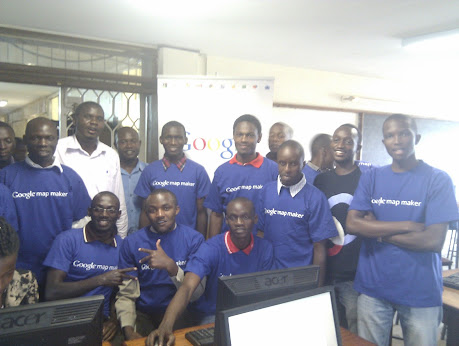
Makerere University Business School held its mapping event on 17th September 2012where students added places on the map around MUBS and Inside the University. The Google Stu­dent Ambas­sad­ors  Ssebandeke Ashiraf and Gashumba Michael who led stu­dents in a hands-​on train­ing on how to use Google Map Maker and also in car­ry­ing out map­ping. The event proved to be a great plat­form for shar­ing ideas on tech­no­logy and using simple tech­no­lo­gies avail­able to stu­dents to cre­ate an impact in their communities.

Those who attended were thrilled by the experience and were eager to participate in more upcoming events. They also requested for more time for the mapping and some went as far as trying to map areas from their home districts.

Kakembo Alex “You should add more hours at least the whole day otherwise i have learnt more and it was a nice experience.”

Njeri Louis Maina “I am happy to have learnt something new and valuable today i appreciate Google’s efforts in extending its products to university people”

Nakibuuka Bitijuma “Its really exciting all along i thought putting a place on a map was for computer science and IT guys but me as a business student i can also put a new place”

Tumusiime Ronald “am thrilled by Google mapping experience and i will continue mapping my home district Ntungamo”

 At the end of the exercise more than 60 places were put on map and more edits were made to the areas which were wrongly mapped before.

The areas surrounding MUBS were placed on map and these include hostels, restaurants, bus stops, police stations. Almost all stages in the Nakawa Taxi park were mapped including different stages and offices.

Happy to be a mapper: Students and staff after the event


Photo
Hajara (Business Computing student) with a mapmaker T-shirt
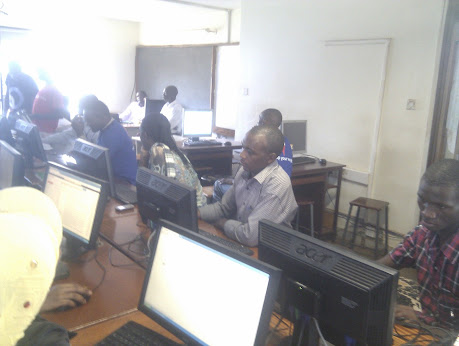
Students adding new places on the map

Photo
Snapshot of MUBS satelite image


The mapping event is back. This time its going to take place on 1st June 2013 at MUBS Annex Bugolobi ICT Centre Labs. To be part of this event please register on the form below to book your place